

You know how it is in this industry right now. We are absolutely swimming in data.
You’ve got your dash cams beeping, your ELDs logging hours, paperwork from the FMCSA, medical cards, maintenance records… and that’s before you even look out the window to see if it’s raining.
Most fleet managers I talk to are overwhelmed. They have all this information, but it’s scattered across ten different login screens. It’s noise.
That’s precisely why we built My Fleet AI.
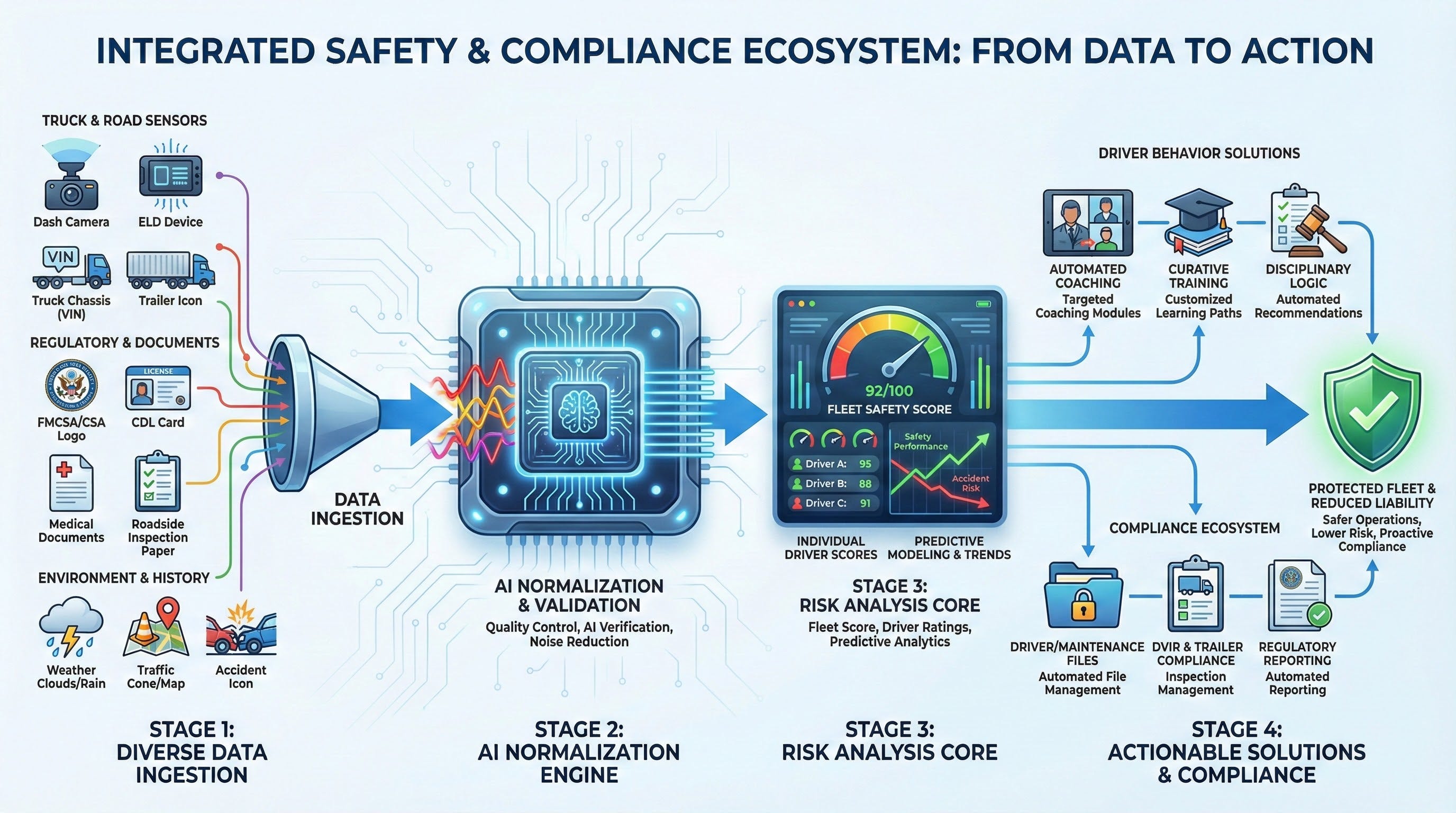
I wanted to show you exactly how our software works, from the moment a wheel turns to the moment you save money on insurance. Think of it as a four-step engine.
Stage 1: The Funnel (We Take It All)
Look at the left side of the diagram. That’s the reality of trucking.
The Truck: We pull data from dash cams, ELDs, and the VIN/chassis itself.
The Paperwork: We digitize the boring stuff—CDLs, medical docs, roadside inspection papers.
The World: We even pull in environmental data like weather and traffic patterns.
We don’t care where the data comes from; we just ingest it. We throw it all into the funnel.
Stage 2: The Filter (The AI Brain)
This is where most software fails, but where My Fleet AI shines. If you just dump all that data onto a dashboard, it’s a mess. You get false alerts and bad info.
Our AI Normalization Engine cleans the house. It validates the data, filters out the “noise” (like a camera triggering because of a pothole, not a crash), and organizes everything into a standard format. It’s quality control on autopilot.
Stage 3: The Scoreboard (Risk Analysis)
Once the data is clean, we can actually use it. The software crunches the numbers to give you a Fleet Safety Score.
Imagine waking up and seeing a “92%” on your dashboard. You know exactly where you stand.
You can see which drivers are your rockstars (Driver A with a 95%).
You can see who needs help (Driver B with an 88%).
You get predictive modeling that tells you where your next accident might happen before it happens.
Stage 4: The Fix (Actionable Solutions)
This is the most important part. Knowing the score is great, but how do you improve it? My Fleet AI doesn’t just give you a problem; it gives you the solution.
For the Driver:
If a driver is struggling, the system automatically assigns curative training. We’re talking automated coaching modules customized to their specific bad habits. It creates a paper trail showing you took steps to help them improve (which lawyers love).
For Compliance:
It handles the backend, too. Automated file management for driver and maintenance files, DVIR tracking, and regulatory reporting.
The Result: The Shield
If you look at the far right of the image, you see the Shield. That’s the goal.
By moving from raw data to automated action, you get a Protected Fleet. Your liability goes down, your operations get safer, and honestly? You sleep better at night knowing the AI is watching the small stuff so you can focus on the big picture.