

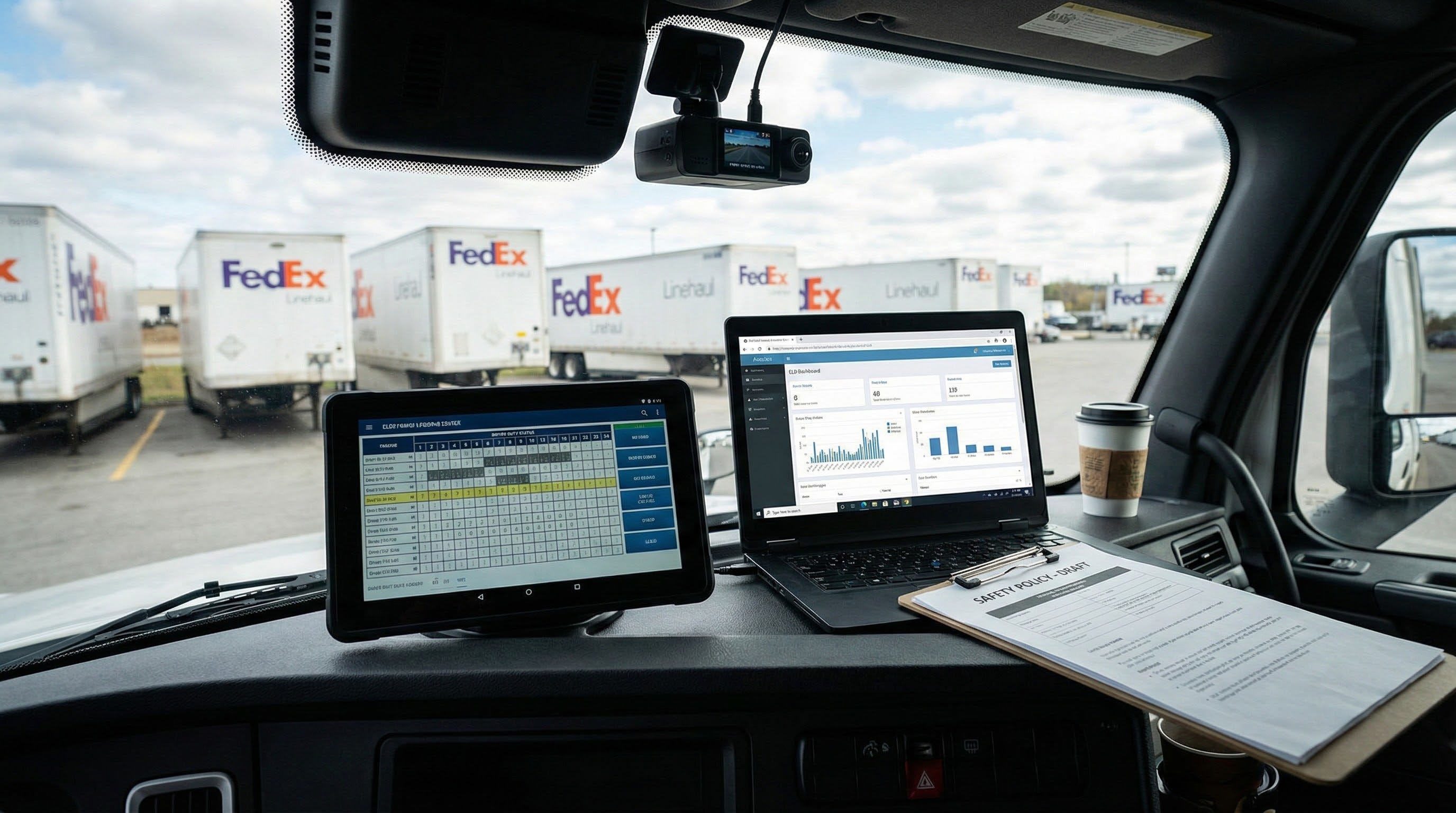
Five years ago, I stepped into the Linehaul space for the first time. I was hired as a Safety Director for a contractor with a fleet of 50 drivers.
Coming from outside the immediate FedEx ecosystem, I walked in with a specific set of assumptions. I honestly thought safety would be a well-oiled machine. I assumed that because we were operating under the umbrella of a logistics giant, the protocols would be rigid, the data would be clean, and the “how-to” would be laid out in a binder somewhere on my desk.
That was not my experience.
It was a rude awakening, but it taught me the most important lesson about this industry: Compliance isn’t given to you; it has to be built.
The Independent Contractor Paradox
The biggest challenge in the Linehaul space is the nuance of the Independent Contractor (IC) model. It creates a unique friction point.
FedEx cannot legally tell a contractor how to run their business day-to-day; they can only set the guidelines and standards within the contract. They tell you the destination, but you have to drive the car.
For example, the contract states you must use approved Video Event Data Recorders (VEDR). It states that data from those cameras determines unsafe driving behavior. But FedEx doesn’t manage that data for you. That is where the chaos usually lives.
The Daily Grind: VEDR and ELDs
When I first started, I realized that having the technology wasn’t the same as having a safety program.
Take the VEDR devices. It’s not enough to just install them. The workflow required to actually manage that data is a full-time job. You have to:
Review the incoming footage daily.
Identify false positives and dispute them with the vendor (a process that takes time and patience).
Coach the drivers on valid events.
Train new drivers before they even hit the road.
Discipline drivers who aren’t improving.
If you miss one link in that chain, like failing to dispute a false event, your safety score tanks.
Then there are the Electronic Logging Devices (ELDs). This was another area where I assumed automation meant “set it and forget it.” I was wrong. Contractors have to be glued to that dashboard to:
Correct logs.
Ensure drivers are avoiding violations in real-time.
Clear “Unidentified Driving” events (which pile up faster than you think).
Enforce “Form and Manner” protocols.
On top of all this, I realized that while contractors should have written safety policies to govern these actions, many simply don’t. They are operating on verbal warnings and handshake agreements, which is a liability nightmare.
The “Trucking Experience” Gap
Why is this such a struggle?
In my experience, it comes down to the origin story of the contractor. Many people enter the Linehaul space as investors or entrepreneurs. They buy routes because it’s a solid business opportunity.
However, buying a business and running a trucking company are two very different skill sets. Many contractors do not have prior trucking experience. They understand P&L sheets and asset management, but the granular, regulatory, and safety aspects of transportation are a foreign language.
They struggle not because they don’t care about safety, but because the learning curve is a vertical wall.
The Bottom Line
Safety isn’t just about preventing accidents; it’s about protecting the investment you made in those routes.
Over the last five years, I’ve seen the industry progress. The technology is getting better, but the scrutiny is getting tighter. If you are still treating safety as something you’ll “get around to” or assuming the technology will manage itself, you are driving blind.
Whether you do it yourself or hire a team, getting your safety policies written and your VEDR/ELD workflows organized is the only way to survive in Linehaul.
Do you handle safety yourself, or do you outsource it? I’d love to hear how other contractors are managing the workload in the comments.